Formulating clean, high-performance water-based flexographic inks that empower printers and protect our ecosystems.
Lorikeet Inks was founded in 2010 with a singular engineering challenge: formulate water-based flexographic inks that match the drying speed and color depth of solvent-based inks, without the hazardous volatile organic compound (VOC) emissions.
What began as a specialized chemical laboratory in Kurukshetra, Haryana has evolved into a trusted manufacturing partner. We serve corrugated converters, packaging printers, and stationery publishers across the country. Our story is built on technical curiosity, customer-centric formulation, and absolute compliance with international B2B quality standards.
Flexible packaging substrates behave differently. We test adhesion, pH stability, and mechanical shear forces directly on target linerboards to prevent ink emulsification.
Our engineering formulations and customer support agreements are driven by three fundamental principles.
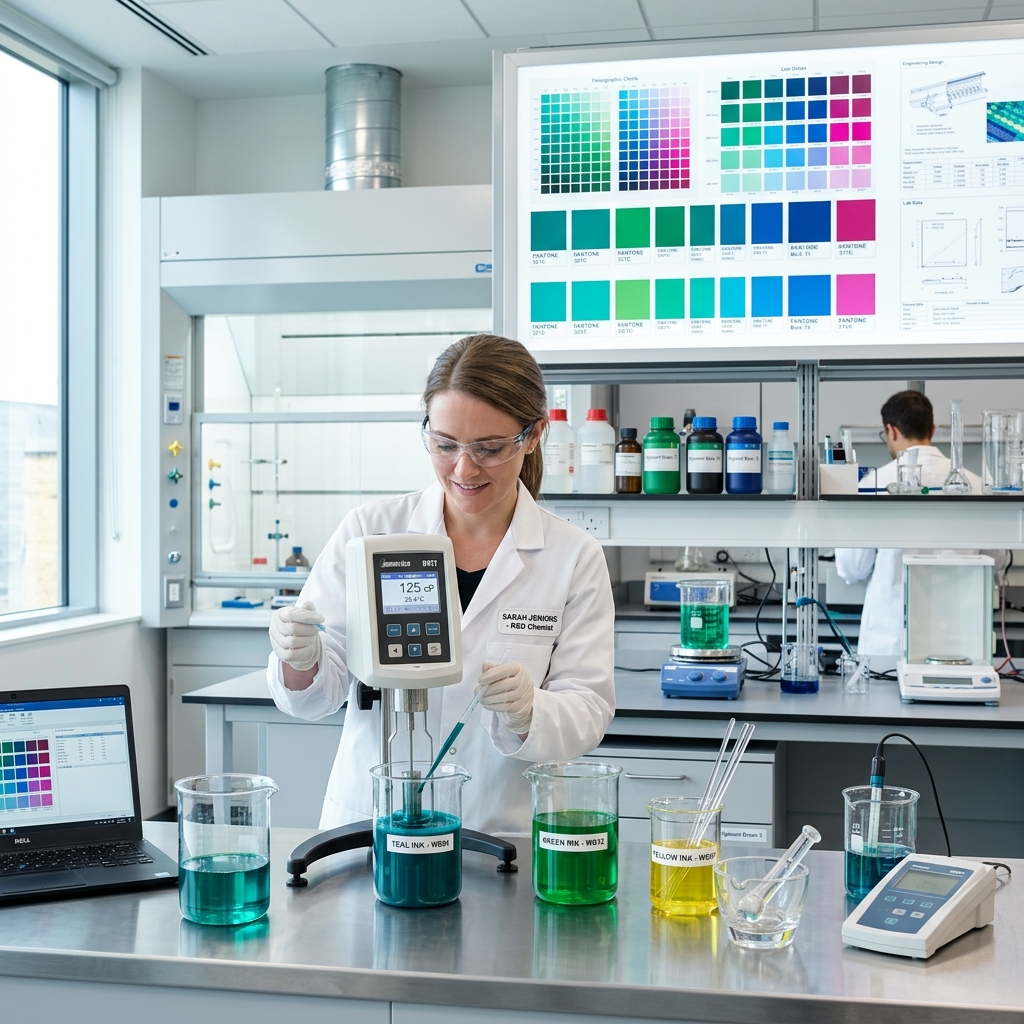
We run an active laboratory in Ladwa to optimize polymer resins, accelerating drying coefficients on high-speed corrugated converting lines.
We formulate water-based products that contain zero solvents and generate no VOCs, reducing hazardous cleanup requirements on printer floors.
We do not just ship containers; we support your press team with drawdowns, press stability trials, and customized ink troubleshooting.
Consistency is paramount in packaging converters. If a batch pH shifts by 0.5 or viscosity by 3 seconds, ink dry rates and transfer characteristics change. At our Haryana plant, we enforce three distinct testing phases for every ink shipment.
Every batch is run through Zahn Cup #2 calibration at 30°C. We maintain strict viscosity envelopes (18s-30s depending on series) to guarantee uniform ink laydown and prevent dot plugging.
Using standard spectrophotometers under D50 light sources, we verify that color values stay within strict Delta-E tolerances (ΔE < 1.0) compared to master print swatches.
Inks printed on corrugated linerboards undergo mechanical friction rub testing to ensure packaging graphics survive packaging transit, high humilities, and shipping handling.